The Universal Struggle of Modern Existence
Part 1: The Presenting Problem
No matter where I go, the silent struggle creeps up behind me. It’s powerful, addicting. It compels me to run until my legs break, and then to crawl forward with bloody fingernails. In high school, it approached my psychological shores as burbling waves. A noticeable shift, but nothing more (not yet). University swung open and the waves drew closer in roaring progressions. The coastal storms were deadly. I was cast into the sea without a life vest more times than I can count. After a while, I learned to navigate the ever-changing tides.
Even though I’m well seasoned, grappling with life after a second graduation, the crashing waves still creep at random hours – when I’m ordering coffee, chatting with friends, driving to work, or trying to fall asleep. This metaphorical struggle can be summarized with the following statements…I’m not enough. I should be doing more. I need to become more. Why am I not enough?
Let’s pause before diving into the proverbial deep end.
It’s interesting, being young in this society. Whether you’re born at the turn of the century or well into it, life as we’ve learned is immensely complicated. There’s endless inflation, neglected global warming, mental health epidemics, corrupt officials, job insecurities, and countless more, each deserving their own essays. Problems are inevitable. A century ago, the average household still worried about affording groceries. What makes this era unique is not the issues around us, but rather how readily they enter our lives. The next time you take the bus, or order a coffee at your favourite café, look around. Chances are most people will be staring at a screen. I’m not ridiculing this behaviour. I’m guilty of scrolling endlessly too.
Part 2: The Deep End
When I take a step back, I can’t help but ask, How does this lifestyle impact us? What happens when a teenager grows up with a smart phone in his pocket, reminding him, repeatedly, how difficult the world is becoming and that everyone around him is doing better? I’m not saying that social media is the main culprit, but it doesn’t feel like the solution.
When it comes to my digital adolescence, this lifestyle created one object to symbolize my twenties: a pressure cooker. I could expand further, but Brené Brown explained it best… “We live in a culture of never enough: never good enough, never perfect enough, never thin enough, never powerful enough, never successful enough, never smart enough.”
The need to seek this elusive enoughness is, what I like to call, the Universal Struggle of Modern Existence. It comes in many forms. For most young people, myself included, it surfaces as the constant urge of having everything established pronto. Do everything now. Life is hard, so we must adapt. It’s impossible, but we can push through. Wait, you’re relaxing while reading this? Shouldn’t you be working on that side project you’ve been procrastinating? Don’t forget to get eight hours of sleep, that way you can stay productive tomorrow. There’s a mountain of emails you haven’t checked, I bet a few can’t wait. So do it, do it now. Get into that graduate program as soon as you can. Achieve that promotion at work as soon as you can. Find your soulmate and save money for a downpayment as soon as you can. If you don’t, well, we all know what happens, don’t we. You’ll get left behind, or better yet, you’ll feel like your pressure cooker will explode any moment.
Anxious? Me too.
It’s sad, isn’t it? This is life for most young people moving forward. Everything feels unbearable. A monsoon of worry greets us before breakfast. It’s heavy, it’s quickening, it’s constant, it’s in me, but it doesn’t have to be this way. What if there was another way?
Not only is modern life complicated, it’s paradoxical. Many of us know that chasing enoughness is a fallacy, and yet, we still get swept away in the waves. We have different lives, with unique ebbs and flows, but a question still remains for all of us to examine: What are we supposed to do in a world that demands and reinforces everything to be accomplished immediately?
We could ask AI to solve this modern issue. ChatGPT will give us a lovely bullet point summary of how to fix this immediately, but would we feel any better? I’m not an expert. I won’t pretend to be one. What I will do though is explore this in the same manner in how I steadied my turbulent soul: with a story.
Part 3: The Young Musician
There was once a young man in his early-twenties who did everything in his power to become a famous musician. It was the 70s in America and soft-rock was booming from coast to coast. He hustled relentlessly, working at countless musical bars late into the night and early into the morning.
His first album flopped. A malfunction during production made the songs play at high-speed, giving him a high-pitch voice. This error filled him with extreme humiliation. The dwindling copies sold sent him into a depressive spiral. He disappeared from the public eye and even moved across the country under a new name. After a few years, the tides shifted. Sales improved, and recognition finally arrived. His proceeding albums did exceptionally well, with many of the hits reflecting conflicts he struggled with: creative survival, career urgency, restless ambition, and failure. He was gaining fame, but a gnawing feeling still clawed ceaselessly. Is this enough? Should I be doing more?
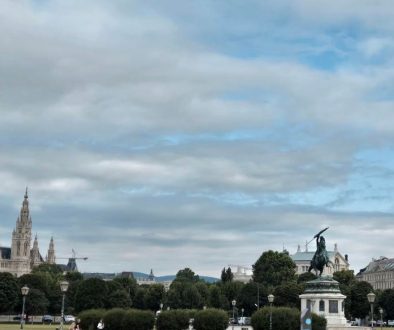
Everything changed when his father, a man estranged from his family, reached out to him. They communicated on the phone several times while he was on tour. He learned that his father was living in Vienna, Austria, and that he had a half-brother he never met before. So, in the middle of a highly successful climb, he decided to drop everything and travel to Europe. He was twenty-six. The last time he saw his father was when he was eight.
When they reunited, his father embraced him warmly. A few days passed and the two went on a walk around the city. While strolling, the young man observed an elderly woman sweeping a cobblestone street. “That’s kind of sad,” he said, “an old lady like that, having to do that kind of work.” His father then replied, “No, you don’t get it. She feels useful, she feels needed. In this society, old people aren’t pushed aside. They still have a place.”
In later interviews, the young man would credit this conversation with shifting his outlook and philosophy.
He listened closely and heard a fresh tune chime in his heart. There was no need to rush. He could sit, relax, and collect his thoughts. Life was still difficult, but everything did not have to be achieved through a giant sprint while he was young. It could unfold organically, on its own time.
There’s still time. He has a role play. We all have a role play, however small, however hidden, just like the old lady sweeping the cobblestone street.
The young man returned home and wrote a song inspired by this experience. It didn’t make a tremendous splash from initial sales, but that didn’t matter. Something took root in his soul, and the young man, Billy Joel, would grow from a talented singer to a legendary artist. Decades will pass, but eventually, the song, Vienna, will gain significant cultural traction. In 2023, just shy of the song’s fiftieth anniversary, The Observer coined it an “enduring masterpiece.”
Part 4: A Lyrical Denouement
Words cannot justify how much this song resonantes in my life (which is probably why I wrote a mini backstory about its creation). The lyrics are simple, potent, and wise. When I listen to Vienna, it almost feels like someone is lifting me from heavy wreckage. They pull me up where the air is fresh and the horizon is clear, and they tell me, hey man, I get it, but it’s going to be okay.
When asked about the meaning behind the song, Joel replied, “Slow down, look around you and have some gratitude for the good things in your life. That’s what Vienna represented to me”.
This isn’t to say that listening to this song during your next car ride will solve all your problems. That’s ludicrous. Billy Joel’s story and the lyrics behind Vienna can nevertheless teach us a valuable lesson.
We are born in an inherently complicated world, with complicated systems and complicated issues. It often feels like everything gets funnelled into our heads, leaving us anxious, numb, or jaded. These problems won’t go away anytime soon (unfortunately). Yes, it’s a complex world we live in, but that doesn’t mean the solutions need to be.
Maybe what will help us is taking a page out from Joel’s lyrical book…
Slow down, you crazy child
You’re so ambitious for a juvenile
But then if you’re so smart
Tell me why are you still so afraid?
I think about those last lines repeatedly, if you’re so smart, tell me why are you still so afraid? To me, it speaks to a subtle declaration: the intellect, despite all its glory, can still be afraid by its capacity to imagine.
The elusive enoughness we constantly seek involves comprehending something out there, beyond the present, which we process through our mind’s eye. It’s powerful, addicting. Modern society praises intelligence: critical thinking, being productive, doing more, and solving more problems.
Maybe that’s it. Maybe it isn’t about getting things done and solving more problems. Perhaps the real paradox of the Universal Struggle of Modern Existence is that we can’t seek something that we already possess. The lack of enoughness we experience is us getting lost in our heads. It was never about reaching and solving further. It’s about listening, witnessing, but most of all, accepting. Life will unfold uncontrollably whether we like it or not. The only true certainty is uncertainty. You don’t have to chase life that seems to speed forward. You can ground yourself, soak in the air around you, and if you look closely, life can gently approach you.